Building Serai in the open
Why we're building hospitality's integration layer as a commons the industry keeps — and what this blog will carry as we go.
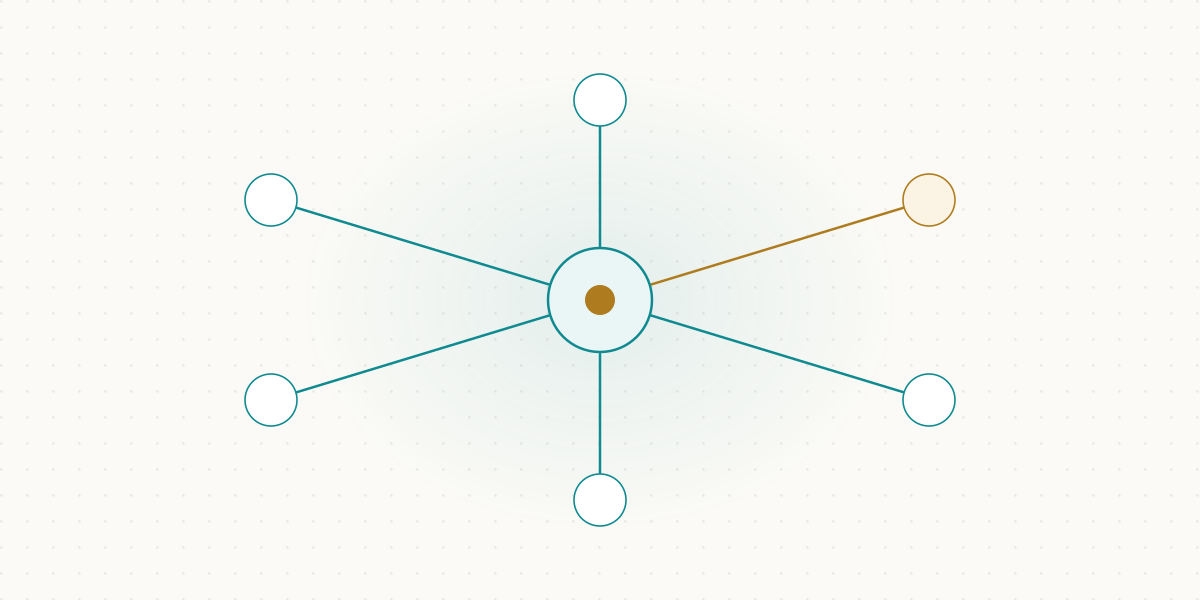
A hotel doesn't get to do what it wants with its own stack. New flows, new guest experiences, a quick experiment — each one turns out to be a vendor project, on their roadmap, at their price. So it doesn't happen. Meanwhile the effort runs the other way: staff re-type what the systems should be telling each other, folios drift out of sync, reports get stitched together by hand. The cost isn't a line item. It's control.
That problem is why Serai exists, and this first post is about how we intend to build it — out loud, on the record, and as something the industry keeps rather than rents.
What Serai is
Serai is an integration layer for hospitality. Every system gets one wire to a shared model — the Linked Commons Model — instead of a bespoke integration to every other system it needs to talk to. Systems already in place stay in place. Replace one and the others never notice. For the first time, the stack can follow the hotel's design instead of the vendor's.
The layer translates and routes. It is never a system of record. A hotel's data keeps living in the systems the hotel already owns, reachable now through one ordered feed rather than a dozen brittle point-to-point links. Nothing proprietary sits between a hotel and its own events.
Why we're building it in the open
The hardest part of a shared layer isn't the code. It's trust. A hotel has every reason to be wary of a new dependency in the middle of its stack — because that's usually where the next lock-in gets installed. So the answer can't be "trust us." It has to be structural.
A commons you keep, not a hub you rent.
Concretely, that means a few commitments we're holding ourselves to in public:
- The Linked Commons Model is documented and versioned, and it is being built to become an open standard — released under Apache-2.0 at a published maturity gate, not at anyone's discretion.
- Governance of the model and the certification program will transfer to the Serai Foundation, an independent, vendor-neutral body, when that gate is reached.
- Niji Labs is Serai's first certified implementer — not its owner. Serai is not our product; we're the first to build on it, and the standard is deliberately insulated from any one company bending it toward itself.
None of that is true because we say so. It's true because it's written down, versioned, and headed for a governance handoff that takes it out of our hands. That's the point.
What this blog will be
Building in the open only means something if the reporting is honest when the news is dull or bad. So that's what this will be: a plain, roughly bi-weekly account of what we shipped, what we didn't, and what we learned — connector by connector, decision by decision. Some posts will be architecture. Some will be a single hard call and why we made it. Some will just be a status line that reads "still in progress," because that's the truth that week.
If you run a hotel, build the systems hotels depend on, or integrate them for a living, this is the room where you can watch the thing get built — and, if it's useful, help shape it before the gate closes on the founding decisions.
We'd rather be judged on what we publish than on what we promise. So — here's the first one.